Disclosure, upfront
AtlasHour is currently in an ownership transition to JBRH Digital, the company that builds Maya. The outgoing owner is retaining technical operation of this site until that transition agreement completes. This feature is published under that relationship — it is a Founder/Owned-Company feature, not arm's-length independent coverage, and we are labeling it that way rather than letting it read as neutral third-party journalism. Every capability, limitation, price and safety claim below was checked directly against the live MayaByJBRH.com site and its working product demo on 2026-07-22 and 2026-07-23, not copied from marketing copy.
What Maya actually is
Maya is a voice-and-text AI receptionist built by JBRH Digital, sold under the name "Maya by JBRH." She runs on a tablet, wall kiosk, smart display, an existing TV, a mobile stand, or a visitor's own phone, and she speaks and listens using OpenAI's realtime voice models — the same class of technology behind the current generation of voice AI products. JBRH Digital describes her as a "front desk, safety and operations employee" rather than a chatbot, and that framing matters for what follows: the company is explicit that a chatbot answers questions, while Maya is built to complete outcomes — registering a visitor, checking a colleague's availability, booking a slot, sending the confirmation, and closing the loop.
You can test the real product yourself, free, without signing up: MayaByJBRH.com runs a live voice demo of Maya on its own homepage.
The problem it is trying to solve
Every organisation with a physical counter — a hospital ward, a hotel lobby, a clinic, a corporate office — has the same recurring failure mode: nobody is at the desk when a visitor needs help. It happens before opening hours, during a lunchtime rush, after the shift changes, or late at night. The visitor waits, guesses, or leaves. JBRH Digital's pitch is that this gap is not a staffing problem to solve with more people, but a coverage problem that a properly bounded AI employee can close without pretending to replace human judgment on anything sensitive.
The company's own materials frame six specific operational pain points it says Maya addresses: inconsistent counter coverage, missed WhatsApp and email conversations, appointment overload, queue pressure, slow safety response, and poor visibility for the owner or manager into what actually happened at the counter that day.
How this differs from a chatbot or a kiosk
A standard kiosk or IVR menu is a static decision tree: press 1 for appointments, press 2 for billing. A chatbot answers a question and stops. JBRH Digital's central claim — one we can independently confirm is at least architecturally coherent, based on the live demo and the site's own capability breakdown — is that Maya is built to chain a conversation into an actual completed task: understand why a visitor is there, register them, check whether the person they are looking for is free, book or reschedule the appointment, send a WhatsApp or email confirmation, and log the whole interaction into a daily report a manager can review.
The distinction the company draws in its own FAQ is worth quoting directly, because it is the clearest statement of what it is selling: "A chatbot or IVR answers questions; Maya completes outcomes. She can register the visitor, check availability, notify the right person, book the meeting, prepare the follow-up and confirm it was done — coordinating real front-desk, appointment, communication, safety and reporting workflows, not just replying."
What Maya can actually do right now — and what is still a roadmap item
This is the part most AI-product coverage skips, and it is the part that matters most if you are deciding whether to deploy this at a real counter. JBRH Digital publishes its own maturity breakdown for every capability on the Maya site, and it is unusually candid: of 85 listed capabilities, only 2 are marked "live to try now" in the public demo, 33 are "ready to configure" during a paid installation, and 50 are explicitly labelled "on the roadmap" — meaning they are not built yet.
Verified as currently working or configurable at installation:
- Multilingual voice reception in English, Telugu, Hindi, Tamil, Kannada and Malayalam, continuing naturally in whichever language the visitor starts speaking, without asking them to select one first.
- Visitor, customer and patient registration, with a queue token issued when that feature is enabled.
- Appointment booking, rescheduling, reminders and no-show recovery, coordinated with host or staff availability.
- WhatsApp Business and business-email handling — intent understood, replies drafted, sensitive sends held for human approval. Maya connects only through an authorised WhatsApp Business account; JBRH Digital states plainly that she cannot and does not access a private WhatsApp account.
- Queue guidance, indoor directions and billing-question assistance, with disputes, refunds and exceptions routed to staff.
- Authorised-camera safety-event monitoring with human confirmation before any escalation — covered in detail below.
- Daily operational reporting: completed work, open follow-ups and exceptions summarised for a manager to review.
Explicitly on the roadmap — not currently live, according to JBRH Digital's own capability tracker:
- Automatic fall detection and response.
- Smoke or visible-flame detection.
- Crowd-density awareness and overcrowding alerts.
- Unattended-object detection.
- Reading a visitor's situation from visible context (for example, recognising someone is carrying a delivery) without being told.
- Real-time speech-to-speech interpretation between two people who do not share a language.
If a vendor or reseller describes any of the roadmap items above as available today, that is a claim to verify against the product directly — JBRH Digital's own site does not currently back it.
A day with Maya
JBRH Digital's site walks through a single working day, and it is a useful way to see how the pieces are meant to connect — provided you read it as the company's stated design, not an audited case study, since AtlasHour has not observed this running at an actual customer site.
The day starts at 8:30am with Maya checking the reception device, its approved integrations, and the day's schedule. A visitor is welcomed and registered at 9:05am, issued a queue token in their own language. By mid-morning an appointment is booked without interrupting staff, and just after noon a WhatsApp enquiry is answered and a follow-up created. In the early afternoon, the system says it notices queue pressure building and sends the manager a short alert before wait times become a visible problem. Late in the day, approved rescheduling messages go out to people who did not show up for their slot, and by 8pm a daily summary is prepared — completed work, open items, and exceptions, ready for a human to review. The one entry that matters most for this piece: at 11:40pm, the site describes an authorised camera flagging "possible" after-hours movement. Maya's stated response is to alert the configured contacts and wait for a human to confirm before anything further happens. Nothing is placed at that hour without a person acknowledging it first, by the company's own account.
Where this is aimed: hospitals, clinics, hotels, offices
JBRH Digital positions Maya for any organisation that runs a physical front desk, and lists two groups by name: healthcare — hospitals, clinics and diagnostic centres — and hospitality and services — hotels, salons, schools, offices and retail. The product's "mode" concept lets the same underlying assistant present as a hospital desk, a hotel concierge, a security desk, a sales desk or a billing desk, with the knowledge and conversation pattern changing around it rather than the software itself changing.
In the hospital mode shown in the demo, Maya's stated responsibilities are patient registration, scan preparation guidance, appointment and queue handling, and escalating billing questions rather than resolving them herself. A sample exchange the company shows: a patient asks where to go for a 10:30am CT scan, and Maya verifies the appointment and directs them to imaging reception — a small, concrete, low-risk task, not a clinical one.
Safety, privacy and the human-confirmation boundary
This is the section that deserves the most scrutiny, because it is also where an AI vendor has the most incentive to overstate what the system does unsupervised. JBRH Digital's public language is more careful than most in this category, and it is worth quoting its safety boundary exactly rather than paraphrasing it: "Maya never independently calls police, fire or ambulance services. Emergency calling requires human confirmation unless a separately approved and legally permitted protocol applies."
The company makes several other specific, checkable claims about limits on what Maya is allowed to do:
- She does not infer identity, age, gender or health from camera images, and does not make independent clinical decisions.
- Camera monitoring only covers sources and zones an organisation deliberately authorises — not blanket surveillance.
- Sensitive camera analysis can run at the edge, can be configured to store no video or incident clips only, can blur faces by default, and can auto-delete on a retention policy the customer sets.
- Access is role-based, with an audit trail for sensitive actions, approvals, changes and handovers.
- Data handling is described as designed to support a customer's own privacy and India's Digital Personal Data Protection (DPDP) obligations — but the company is explicit that actual compliance depends on the customer's own configuration, notices, lawful purpose and contracts, not on Maya alone.
None of this is independently audited by AtlasHour; it is what the vendor states publicly about its own product, verified to be genuinely present on the live site rather than invented for this piece. Anyone deploying camera-based monitoring in a hospital or clinic should treat "human confirmation required" as a specification to hold the vendor to during a pilot, not a promise to take on faith.
What it takes to deploy Maya
According to JBRH Digital, no special hardware is required — Maya can run on a tablet, a wall-mounted kiosk, a smart display, an existing television, a mobile stand, or the visitor's own phone. Business-system integrations, any authorised cameras, and operational workflows are configured during installation and depend on the plan selected. The company states the live voice demo works immediately, with no sign-up and no payment card, and that a full deployment's scope — how many locations, which channels, how many languages — is quoted individually rather than sold as one fixed package.
Pricing, as published on the site at the time of writing: plans start at ₹4,999 as a one-time implementation fee plus ₹2,999 a month, excluding GST, then scoped up from there depending on what a specific organisation actually needs. JBRH Digital says WhatsApp, telephony, payment-provider, hardware and unusual third-party usage charges may apply on top of that base plan.
What we saw, firsthand
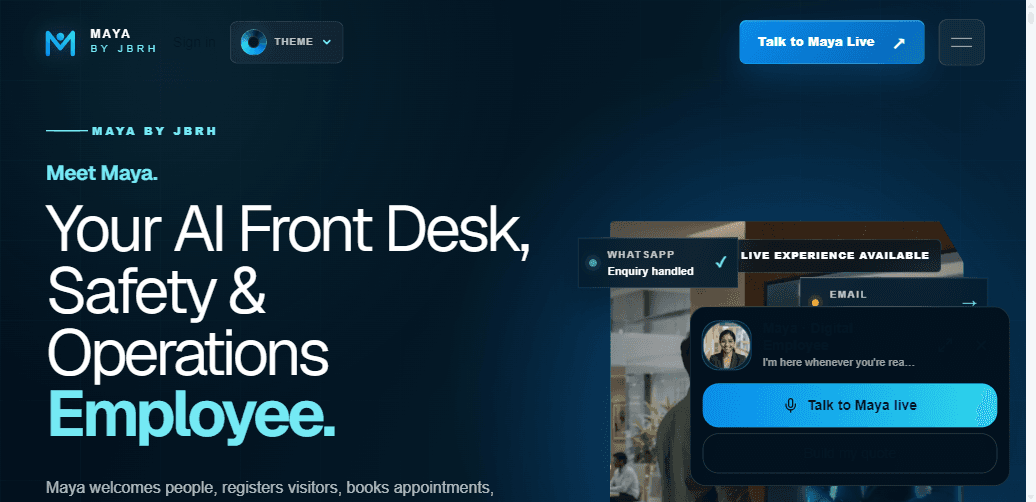
AtlasHour tested the live product directly rather than relying only on the marketing site. The image at the top of this piece is a screenshot AtlasHour captured directly from MayaByJBRH.com's homepage on 2026-07-23 — not an asset supplied by JBRH Digital. The homepage's live voice widget answered in character as "Maya" without requiring an account, and the site's own transparency section states — as of the same dates — 12 live voice-demo sessions recorded, described by the company itself as "real sessions from visitors like you — not customer testimonials," a number it says is live and will grow. We are reporting that figure as-is: a small, early, and honestly-labelled number, not evidence of scale.
Notice also that "Maya" is a common name in this product category — there are several unrelated "Maya" AI assistants from other companies. This piece is specifically about Maya by JBRH at MayaByJBRH.com, and should not be read as coverage of any similarly-named product from a different vendor.
Honest answers to the obvious questions
Is this just a chatbot with a friendlier name?
JBRH Digital says no, and the mechanism it describes — coordinating registration, scheduling, messaging, safety alerts and reporting into one workflow rather than answering isolated questions — is architecturally different from a scripted chatbot, based on what we observed in the live demo. Whether that coordination holds up under real, messy front-desk conditions at scale is something only a live deployment, not a demo, can prove.
Can Maya call emergency services on her own?
No. By the company's own explicit statement, she never independently calls police, fire or ambulance services; that always requires a human to confirm, unless a separate, legally permitted protocol has been specifically approved for that site.
Does she recognise who visitors are from camera footage?
No. JBRH Digital states Maya does not infer identity, age, gender or health from camera images and does not guess at any of those attributes.
Can she read a private WhatsApp account?
No. WhatsApp features run only through an authorised WhatsApp Business connection configured for that organisation.
What does it cost to try?
Nothing, for the live voice demo — no sign-up, no card. A real deployment starts at ₹4,999 implementation plus ₹2,999 a month, excluding GST, scoped up from there.
Is any of this independently verified beyond the vendor's own claims?
Partly. We verified that the site, the live demo, the FAQ language, the pricing and the founder attribution genuinely exist and match what is described here, as of 2026-07-22 and 2026-07-23. We did not independently audit a real hospital or hotel deployment, and no customer testimonials currently appear on the site for us to check.
How we reported this
This feature was built from primary sources only: a full read of MayaByJBRH.com's rendered site (not just its static HTML, which turned out to serve an identical shell for every URL and required a real browser to inspect), the live capability explorer with its own stated maturity levels, its published FAQ, its stated pricing, and its safety-and-privacy section, all captured on 2026-07-22 and 2026-07-23. No customer names, quotes, or outcomes are cited, because none currently appear on the product's own site — we are not inventing any. The founder attribution ("V Sri Krishna Kanth, Founder, JBRH Digital") and the grievance contact (grievance@mayabyjbrh.com) are both taken verbatim from the site's own "Who's behind Maya" section.
As disclosed above, AtlasHour is in an ownership transition to JBRH Digital at the time of publication, which is why this runs as a labelled Founder/Owned-Company feature rather than as independent reporting.
To see the live product for yourself, including the same voice demo we tested, visit MayaByJBRH.com.
Read the source contextThe consequence layer
AI front-desk products are being sold into Indian hospitals, clinics, hotels and offices with little independent scrutiny of what's actually live versus roadmap.
Patients, guests and staff interact with these systems directly, and the businesses evaluating them need to know the real boundary between what's built and what's marketed.
What To Watch Next
Whether JBRH Digital publishes real, named customer deployments and outcomes as adoption grows, and whether the current 12-session demo count scales into genuine usage data AtlasHour can independently verify in a follow-up.
Three facts to keep in view
MayaByJBRH.com (official product site)
Designed for a concise world-news brief.
Used for editorial story mapping and source context.
Related Stories

Beyond Bitcoin: Why the next crypto race will be won by banks, not traders
Crypto's next chapter isn't about soaring token prices. It's about whether banks and financial institutions can trust the technology enough to use it for real-world payments, settlements and tokenised assets.

Airbus to test folding wings for next generation of bestselling planes
Such technology solves problem of longer, thinner, energy-saving wings not fitting in airports around the world

Fed up with World Cup goals called offside for a stray toe or two? A Canadian soccer trial could fix that
Marginal offside calls, aided by technology, have been widely criticized in the FIFA World Cup 2026 for sucking the immediacy, momentum and joy out of soccer. But the Canadian Premier League believes it's at the forefront of a solution, as it trials what has been called the "daylight" offside rule in a bid to give more impetus to goal scorers.
More From This Section
Fed up with World Cup goals called offside for a stray toe or two? A Canadian soccer trial could fix that
Marginal offside calls, aided by technology, have been widely criticized in the FIFA World Cup 2026 for sucking the immediacy, momentum and joy out of soccer. But the Canadian Premier League believes it's at the forefront of a solution, as it trials what has been called the "daylight" offside rule in a bid to give more impetus to goal scorers.
AtlasHour updates articles as new verified information becomes available. Corrections and source context can be sent to the newsroom.