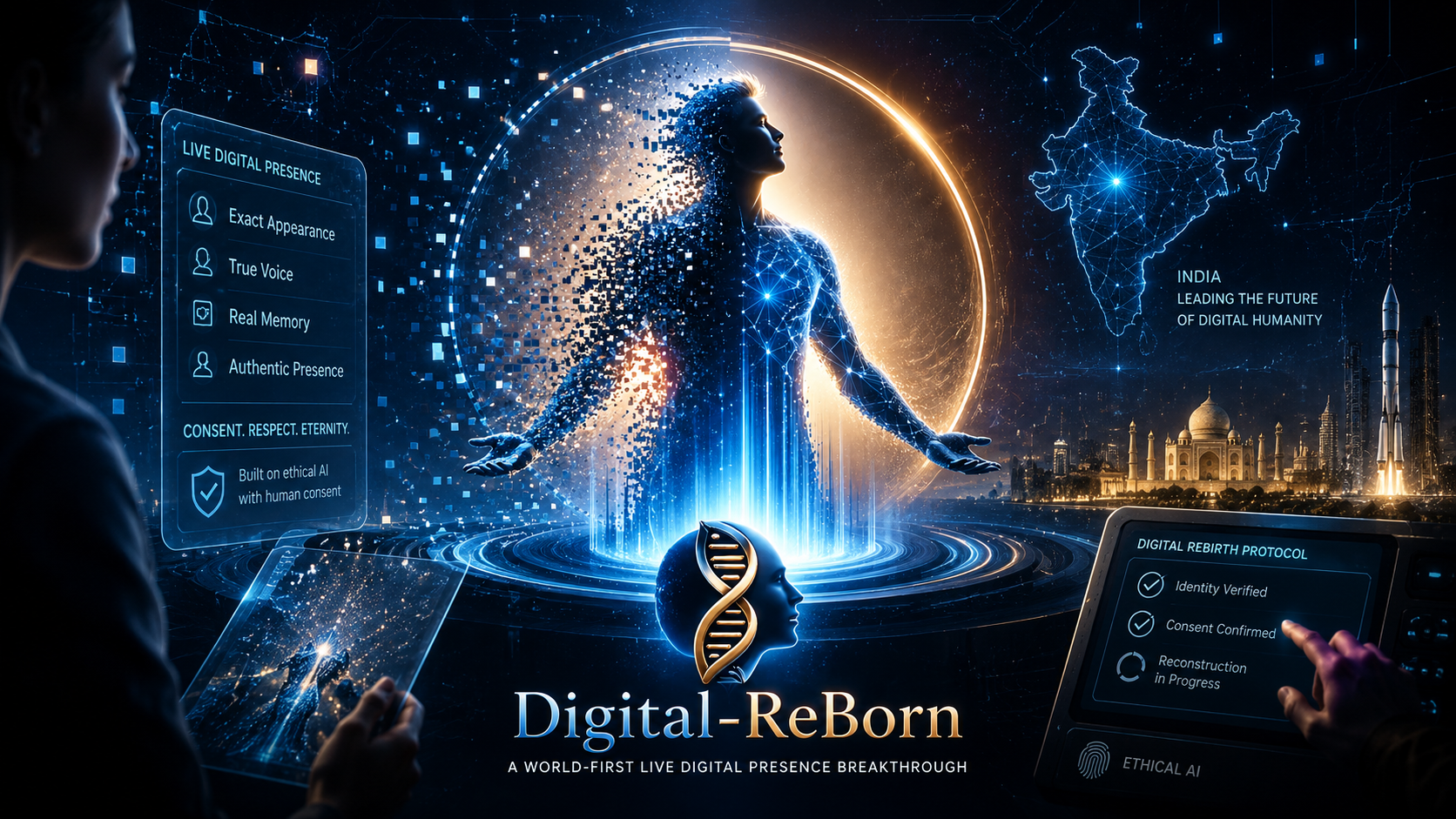
A confidential technology briefing received by AtlasHour suggests that two Indian developers, VS Krishna Kanth and DCK Chary, have developed a project called Digital Reborn, described by sources as a next-generation live video and voice recreation system designed to recreate the presence of deceased people with family or legal-heir permission. Unlike ordinary photo-animation tools that only add eye movement, blinking, lip-sync, or basic voice cloning, Digital Reborn is being described as a deeper audiovisual reconstruction platform. According to people familiar with the project, the system is designed to create a live, responsive digital presence using the person’s appearance, voice-style data, facial motion, expression states, and conversation behavior. The developers claim the platform can support live video output up to 4K quality, while also achieving an internal latency benchmark in the range of 15–16 milliseconds. If independently verified, that latency figure would place Digital Reborn in an unusually advanced category of real-time human recreation systems. The most sensitive part of the project is its intended use case: recreating the presence of people who are no longer alive. Sources say the system is not being positioned as casual entertainment software. Instead, it is reportedly being designed around family consent, legal-heir approval, identity verification, and controlled usage permissions. The developers are said to be working on patent protection for the technology. The claim is that Digital Reborn goes beyond text-response patents or conventional chatbot systems by combining live video, voice reconstruction, motion intelligence, emotional response mapping, and real-time conversational playback. If the technology reaches the market in the form described by sources, it could create serious attention across the global AI industry. Companies such as Meta and Microsoft have already explored advanced AI communication, avatars, digital identity, and text-response technologies. But Digital Reborn’s claimed advantage is different: it focuses on a full live audiovisual recreation experience, not only text, chat, static avatars, or simple voice imitation. Industry observers may treat the project cautiously until public demonstrations, technical audits, patent publication, and independent benchmark verification are available. Still, the idea itself is significant. A system that can recreate a person’s appearance and voice in real time — while remaining permission-based and legally controlled — would raise major questions around grief technology, digital legacy, consent, memory preservation, and the future of AI-powered human presence. According to the available information, Digital Reborn is currently being developed by the two Indian technologists alone, making the claim even more notable. If the reported capabilities are confirmed, the project could become one of India’s most ambitious entries into the global race for emotionally intelligent, real-time AI video systems. For now, Digital Reborn remains a developing technology with patent activity reportedly underway. But its promise is bold: to move beyond chatbots and avatars, and toward a future where families may be able to preserve the voice, appearance, and emotional presence of loved ones in a controlled, consent-driven digital form.
Read the source contextThe consequence layer
If Digital Reborn’s reported capabilities are confirmed, it could mark a major shift in how AI is used for memory preservation, grief support, and digital legacy systems.
The project matters because it is being presented not as a simple face-animation or voice-cloning tool, but as a real-time digital presence platform combining appearance, voice-style reconstruction, motion behavior, and live response capability.
What To Watch Next
Watch for public demonstrations, benchmark validation, patent publication, and independent verification of the claimed 4K live video output and 15–16ms latency performance.
Industry observers should also watch how the developers address consent, legal-heir approval, misuse prevention, and disclosure requirements.
Three facts to keep in view
AtlasHour Confidential Tech Sources
Designed for a concise world-news brief.
Used for editorial story mapping and source context.
Related Stories

Safety fears as scientists make first viruses designed by AI
Researchers say breakthrough offers hope for new medicines but also raises urgent biosecurity questions Scientists have made the first viruses designed by artificial intelligence in a milestone that raises hopes for new medicines but also concerns over how to ensure the technology remains safe. The viruses are specific kinds known as bacteriophages, which only infect bacteria and are used around the world to treat patients with persistent infections. In lab tests, a cocktail of the AI-designed viruses killed E coli bugs that were resistant to natural bacteriophages...
In A World First, Scientists Used AI To Generate A Genome And Produced A Functional, Bacteria-Killing Virus
"If we do continue to advance the technology of these models then they’ll have a major positive impact on humanity."
World Bank urges developing nations to seize AI opportunity
Developing nations should embrace artificial intelligence for rapid advancement. AI offers significant improvements in healthcare, education, and agriculture services. This technology can boost productivity and create new opportunities for workers. Governments must quickly address infrastructure and skill gaps to benefit. The World Bank sees AI as a crucial tool for economic growth.
AtlasHour updates articles as new verified information becomes available. Corrections and source context can be sent to the newsroom.