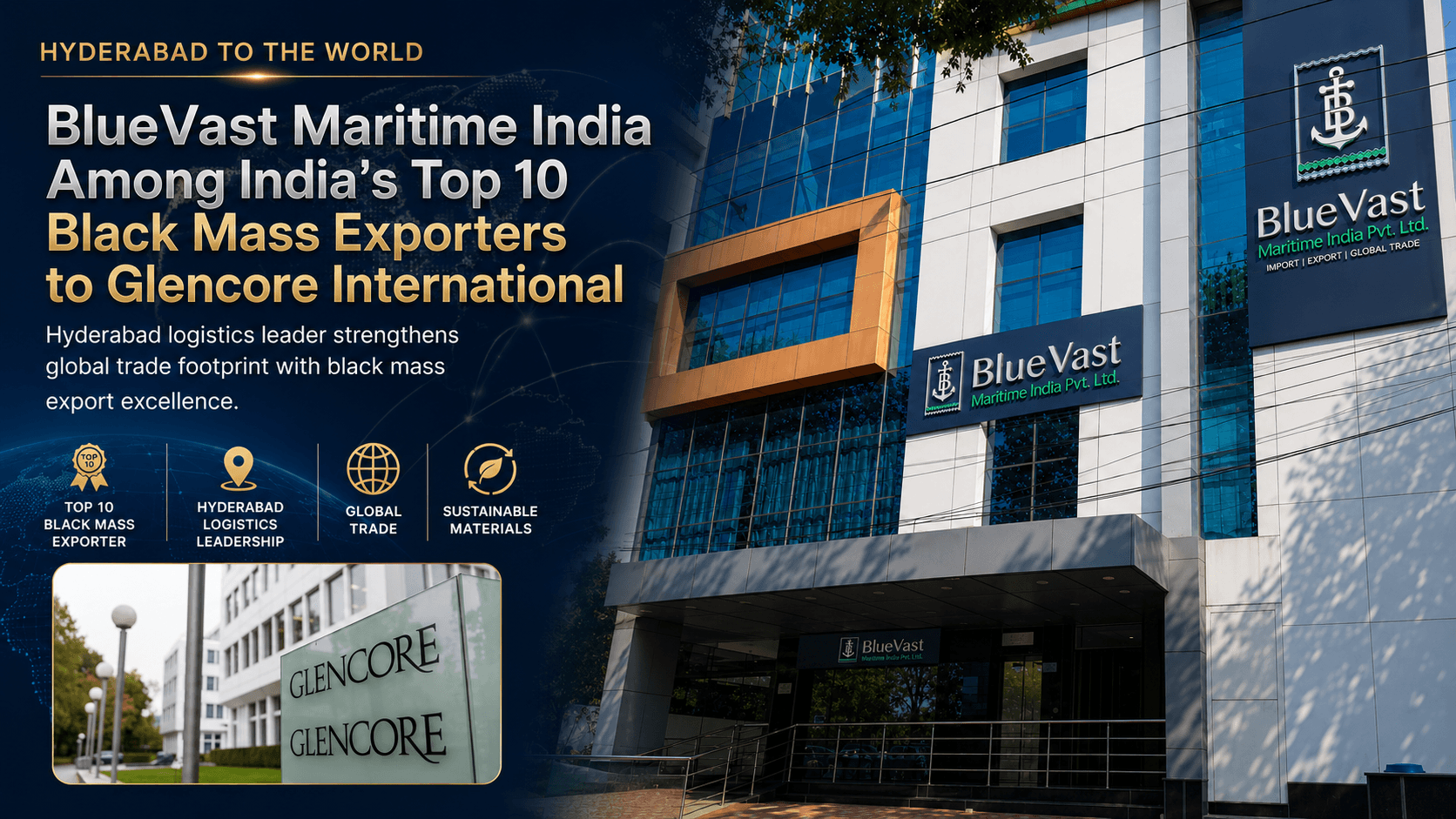
BlueVast Maritime India Pvt. Ltd. is drawing attention in a narrow but strategically important corner of global trade: black mass, the battery-recycling material that sits between end-of-life lithium-ion batteries and the next generation of critical-mineral supply chains. The Hyderabad-based freight forwarding and logistics company is being framed in source-submitted material as emerging among India's Top 10 Black Mass Exporters to Glencore International. AtlasHour is publishing the development as a business-news feature with an important editorial guardrail: public web research did not surface an independent ranking database that verifies a national Top 10 list, tonnage, export value, shipment count, or ranking methodology. That caveat matters. The story is still commercially relevant because black mass exports are not ordinary cargo. They combine commodity-market interest, recycling-linked industrial policy, hazardous-material handling, documentation accuracy, and the operational discipline needed to move specialized material across borders. ## What Happened BlueVast Maritime India is a Hyderabad-headquartered logistics and freight-forwarding company with public service lines that include sea freight, air freight, customs clearance, third-party logistics, transportation, warehousing, project cargo handling, and dangerous cargo handling. Its official site describes the company as a freight forwarder operating since 2013 and lists Hyderabad as its headquarters, with branch presence across several Indian trade locations. The new claim positions BlueVast in a specialized export lane connected to black mass supply into Glencore International. The significance is less about a single shipment headline and more about what the segment requires: controlled documentation, cargo classification awareness, international buyer coordination, multimodal freight planning, and the ability to work inside a compliance-heavy commodity chain. ## What Black Mass Is Black mass is the industry term for the dark, powder-like or filter-cake material created after lithium-ion batteries are shredded and processed. Depending on the battery chemistry and recycling process, it can contain recoverable materials associated with cathode and anode streams, including lithium, nickel, cobalt, manganese, graphite, copper, aluminum, and other constituents. The U.S. Environmental Protection Agency notes that black mass is made up of anode and cathode materials after lithium batteries are shredded, and that its constituents depend on the input batteries and the shredding process. The same regulatory context makes clear why logistics companies must be careful: black mass is no longer a battery, may remain subject to waste or hazardous-waste determinations, and needs accurate handling decisions before movement. For exporters, that turns black mass into a documentation-intensive material. The commercial opportunity is tied to recoverable metals, but the operational challenge sits in classification, packaging, storage, routing, customs paperwork, and counterparties that expect traceability. ## Why Glencore Matters In This Ecosystem Glencore matters because it is one of the global commodity groups with visible activity across metals, minerals, recycling, processing, and industrial marketing. Its recycling business describes work with end-of-life electronics, lithium-ion batteries, and other critical-metal-containing products, supported by a global marketing network. Glencore's Portovesme Critical Raw Materials Hub plan also shows why black mass has become strategically important. In that project context, Glencore has described hydrometallurgical recovery of raw materials from black mass to produce critical battery materials including nickel, cobalt, and lithium. For an Indian logistics company, any export lane associated with a major global commodities buyer requires a higher bar than basic freight booking. The exporter must understand not only shipping movement but the industrial purpose of the cargo, the buyer's quality and documentation expectations, and the compliance sensitivities around recycling-derived material. ## Why This Matters For India India's battery-recycling and sustainable-materials trade is moving from a niche environmental category toward a strategic industrial supply-chain conversation. Electric vehicles, energy storage, electronics, and critical minerals policy are pushing countries to pay closer attention to where recyclable battery materials move and who can process them. India has a strong base in manufacturing, pharmaceuticals, engineering exports, and global services. The next stage of export competitiveness will depend partly on whether Indian companies can handle higher-value, compliance-heavy flows in areas such as battery recycling materials, clean-technology inputs, specialty chemicals, and circular-economy commodities. If Indian logistics firms build credible expertise in black mass exports, they can support domestic recyclers, traders, manufacturers, and global buyers that need reliable material movement. The advantage will not come from volume alone. It will come from shipment discipline, defensible paperwork, safety protocols, and trust. ## Hyderabad's Logistics And Industrial Advantage Hyderabad is already associated with pharma, life sciences, industrial services, technology, and time-sensitive exports. GMR Hyderabad Cargo highlights international connectivity, pharma and temperature-sensitive cargo capabilities, specialized cargo handling, integrated cargo terminals, cold-chain infrastructure, and round-the-clock operations. Telangana's investment promotion material also positions Hyderabad and the wider state as a life-sciences and pharmaceutical manufacturing hub. That background is relevant to BlueVast's story. Companies that grow in pharma logistics often learn how to handle strict documentation, customs coordination, temperature or time sensitivity, customer audits, and high-accountability cargo flows. Those skills are not identical to black mass exports, but they can help create the operating culture needed for specialized cargo. For Hyderabad, the broader point is that logistics capability is becoming a form of industrial infrastructure. A city can have manufacturers and exporters, but without freight forwarders, customs specialists, warehouse partners, dangerous-goods knowledge, and port-airport coordination, high-value supply chains do not scale. ## Business Significance The business significance of BlueVast's emergence in this segment is that black mass export is a trust business as much as a transport business. Buyers need consistent documentation. Sellers need reliable dispatch. Customs authorities need accurate classification. Downstream processors need material that arrives with traceability and fewer surprises. BlueVast's public service mix appears aligned with the building blocks required for that work: international sea freight, air freight, customs clearance, third-party logistics, warehousing, project cargo handling, and dangerous cargo handling. In practice, black mass-linked trade requires a combination of these capabilities rather than a single service line. The segment also gives Indian logistics companies an opening to move beyond commodity freight pricing into advisory, compliance, and specialized trade execution. That is where margins, reputation, and repeat business are usually built. ## Sustainability And Circular Economy Context Black mass sits at the center of a circular-economy question: how can end-of-life batteries become feedstock for new industrial materials instead of waste? The answer depends on collection, sorting, safe processing, responsible transport, and metallurgical recovery. Glencore's recycling messaging frames critical-metal recycling as part of closing material loops. The EPA's guidance shows the other side of the same story: recycling-linked materials can still raise regulatory and safety questions before they become finished products. Sustainable trade is therefore not just a marketing label. It is a chain of decisions that must hold up under operational and regulatory scrutiny. For India, sustainable materials trade could become a visible export lane if companies can prove that material flows are legitimate, traceable, and responsibly handled. That would support both critical-minerals access and the credibility of India's circular-economy exports. ## Editorial Note On The Ranking Claim AtlasHour is using the direct Top 10 framing because it is central to the supplied business claim and article topic. However, public web research did not surface an independent ranking database, government list, customs leaderboard, shipment-tonnage table, or Glencore-published exporter ranking confirming the methodology behind the Top 10 phrase. Readers should treat the ranking as a reported company-positioning claim unless additional public documentation becomes available. AtlasHour is not publishing fabricated tonnage, shipment values, certificates, awards, government approvals, or independent ranking methodology. ## Conclusion BlueVast Maritime India's black mass export story matters because it connects a Hyderabad logistics company with one of the fastest-evolving areas of global industrial trade. The specialized movement of battery-recycling material brings together commodities, critical minerals, circular economy policy, customs compliance, and freight execution. If the company continues to build capability in this lane, the more important story may be larger than BlueVast itself: Indian logistics firms are beginning to compete in export categories where credibility depends on knowledge, compliance, and industrial relevance, not only freight rates. ## FAQ ### What is black mass? Black mass is the recycling-industry term for the material produced when lithium-ion batteries are shredded and processed. It can contain recoverable battery materials such as lithium, nickel, cobalt, manganese, graphite, copper, and other constituents, depending on the battery chemistry and process. ### Why is black mass important for battery recycling? Black mass is important because it can become feedstock for recovering critical minerals used in batteries and energy-transition technologies. Its value depends on chemistry, recovery process, quality, traceability, and regulatory handling. ### What is BlueVast Maritime India Pvt. Ltd.? BlueVast Maritime India Pvt. Ltd. is a Hyderabad-based freight forwarding and logistics company. Its public services include sea freight, air freight, customs clearance, third-party logistics, transportation, warehousing, project cargo handling, and dangerous cargo handling. ### Why is Glencore relevant to black mass? Glencore is relevant because its recycling business is active in end-of-life electronics, lithium-ion batteries, and critical-metal-containing products. Glencore has also discussed black mass recovery in the context of critical battery materials such as nickel, cobalt, and lithium. ### Is BlueVast independently verified as one of India's Top 10 black mass exporters? AtlasHour is using the Top 10 wording as a reported company-positioning claim from supplied material. Public web research did not surface an independent ranking database or published methodology verifying the ranking. ### Why does Hyderabad matter in this story? Hyderabad matters because it has a strong pharma, life-sciences, industrial, and air-cargo ecosystem. Those capabilities support documentation-heavy, time-sensitive, and specialized logistics work that can be relevant to emerging circular-economy export lanes. ### What should readers watch next? Readers should watch for public shipment disclosures, buyer confirmations, regulatory filings, customs or export documentation, sector rankings, and any evidence that India's black mass export lane is scaling through repeat business.
Read the source contextThe consequence layer
BlueVast's reported emergence in black mass exports connects India's specialized logistics capability with battery recycling, critical minerals, sustainable materials trade, and global commodity supply chains.
What To Watch Next
Watch for independent ranking evidence, shipment disclosures, Glencore or buyer confirmations, regulatory documentation, customs classifications, and repeat black mass export flows from India.
Three facts to keep in view
AtlasHour Business Desk
Designed for a concise world-news brief.
Used for editorial story mapping and source context.
Related Stories

Russian strikes kill four near Kyiv, Zelensky makes landmark visit to Serbia
Russian missile strikes killed four people, including a child, in the Kyiv region on Saturday, said local authorities. The attack came hours after Ukrainian President Volodymyr Zelensky arrived in Belgrade on a landmark visit to Serbia, a country with close ties to Moscow. FRANCE 24's Emmanuelle Chaze reports from Kharkiv.

Saudi, Turkey, Pakistan: Deal for joint support amid regional war
Saudi Arabia, Pakistan and Turkey signed a joint defence agreement in Mecca on Friday, aimed at strengthening collective deterrence. Under the pact, an armed attack on any one of the three countries would be considered an attack on all. Simon Moritz tells us more about what’s in the agreement.

Boy Kills Grandparents and Then Five Teachers, Thai Authorities Say
A student killed his grandparents before opening fire at his high school and shooting himself, the authorities said. The episode revived a debate about gun laws.
AtlasHour updates articles as new verified information becomes available. Corrections and source context can be sent to the newsroom.